

The INT Wide Field Survey (WFS) was a major multicolour imaging survey using the Wide Field Camera on the 2.5-m Isaac Newton Telescope, initiated in August 1998. It obtained data over 200+ square degrees to a typical depth of ~25 mag (U through Z), with all data made publicly available worldwide.
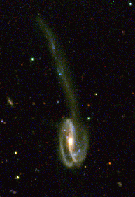
The INT Wide Field Survey (WFS) used the Wide Field Camera, which covers about 0.3 deg², on the 2.5-metre Isaac Newton Telescope (INT) at the Observatorio del Roque de los Muchachos on La Palma. The survey started in August 1998 and was planned to run for up to five years.
The WFS was an umbrella for a number of science programmes chosen by competition. Proposals were judged on the usual criteria, and also on how useful the data would be to others and whether the team could manage the work. Data in several colours were taken over more than 200 square degrees, typically down to about magnitude 25, from the U band to the Z band.
Main features
- Open access: all the survey data were made public for anyone to use
- Several colours: observations in the U, g, r, i, Z and Hα bands
- Depth: typical limiting magnitude of about 25 (U to Z)
- Area: more than 200 square degrees across a number of science fields
- Processing: first-pass calibration and object catalogues produced by the WFS project at CASU
Science programmes
The WFS covered both stellar and extragalactic astronomy, including surveys of nearby galaxy clusters, studies of faint stellar populations and searches for high-redshift objects. The data are still a useful resource today.
Instrument
| Telescope | 2.5-m Isaac Newton Telescope (INT), La Palma |
|---|---|
| Camera | Wide Field Camera (WFC), about 0.3 deg² |
| Start date | August 1998 |
| Depth | About magnitude 25 (U to Z) |
| Coverage | More than 200 square degrees |