
Transforming Data into Discovery
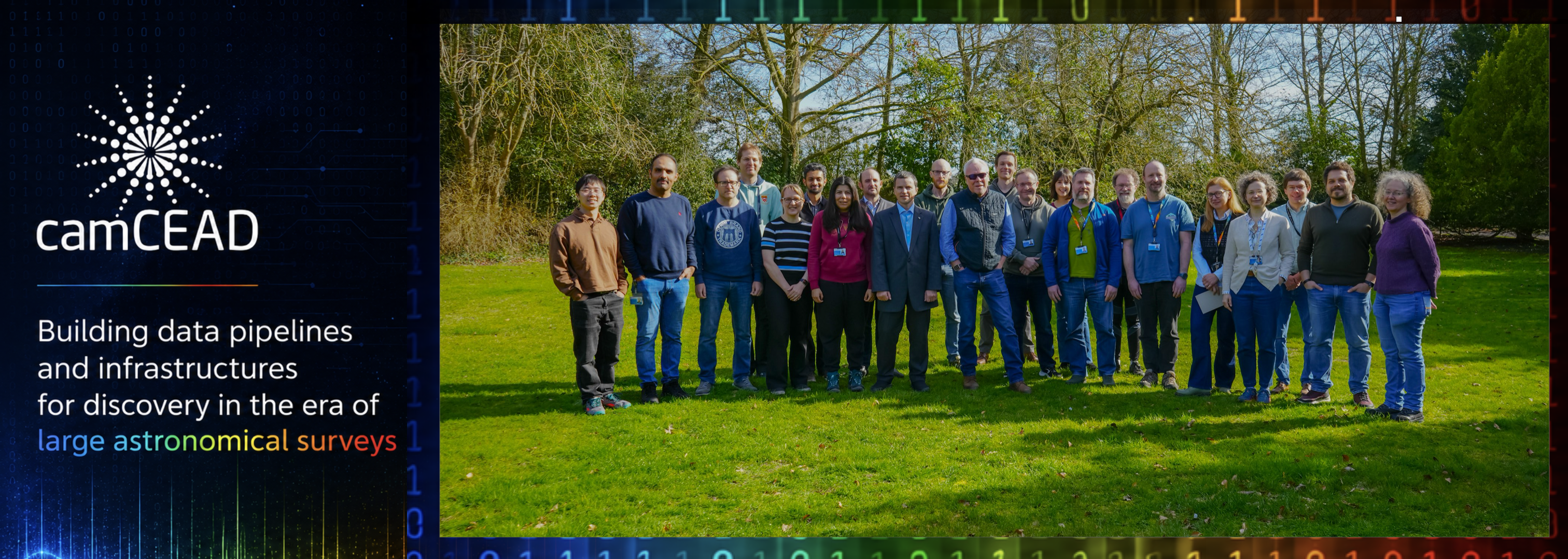
The Cambridge Centre of Excellence in Astronomical Data (CamCEAD), based at the Institute of Astronomy, University of Cambridge, develops the advanced data processing systems, scientific software and computational infrastructure that underpin some of the world's most ambitious astronomical surveys and space missions.
Our mission is to transform vast volumes of complex observational data into high-quality, science-ready products that empower discovery across modern astrophysics. From automated pipelines and cloud-based processing facilities to artificial intelligence, high-performance computing and data-intensive scientific workflows, CamCEAD provides the technologies that bridge the gap between cutting-edge instruments and groundbreaking science.
CamCEAD traces its roots to the Automatic Plate Measuring (APM) machine — a pioneering facility of the 1970s and 80s that digitised sky survey photographic plates and demonstrated how automation and computing could unlock astronomical data at scale. That tradition of pushing the boundary between instrumentation and computation continues to define CamCEAD today.
From Telescopes to Scientific Discovery
Modern astronomy is no longer limited by collecting photons — it is driven by the ability to process, analyse and understand enormous volumes of data. Every clear night, state-of-the-art telescopes and space observatories produce terabytes of observations. Behind every published catalogue, every calibrated spectrum and every scientific discovery lies a sophisticated chain of software, algorithms and computing infrastructure.
Our team develops complete end-to-end data ecosystems, encompassing automated reduction pipelines, quality control systems, survey databases, cloud-based processing centres, web services, visualisation platforms and scientific archives. These systems operate continuously throughout the lifetime of major international survey programmes, delivering reliable data products to thousands of astronomers worldwide.
To support these needs, CamCEAD operates dedicated platforms including CamCEADHub, a collaborative computing environment for survey data analysis, and Darkroom, a specialised processing and visualisation platform for large-scale imaging data.
Enabling the Next Generation of Astronomical Surveys and Space Missions
CamCEAD is a leading partner in some of the world's most ambitious ground-based survey programmes and space missions, providing the scientific pipelines, operational data systems and computational infrastructure that underpin their day-to-day operations.
On the ground, CamCEAD is actively involved in major spectroscopic survey facilities:
WEAVE — the Wide-field Multi-Object Spectrograph at the William Herschel Telescope. CamCEAD delivered the complete central pipeline system and operates the data flow for all WEAVE surveys.
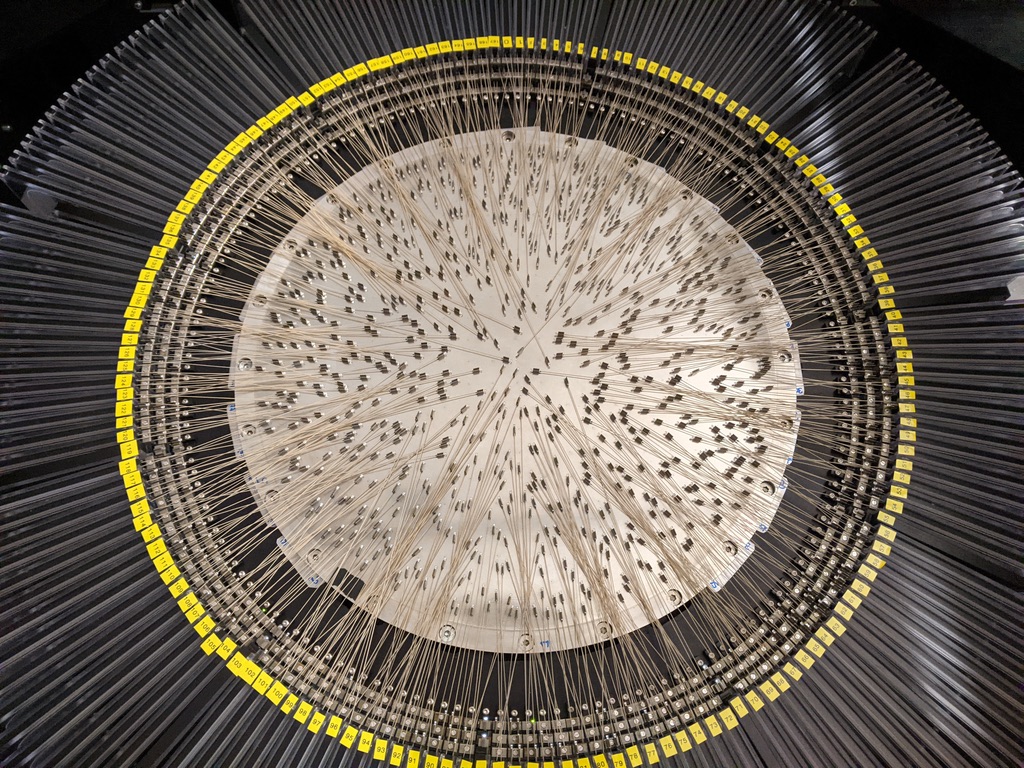
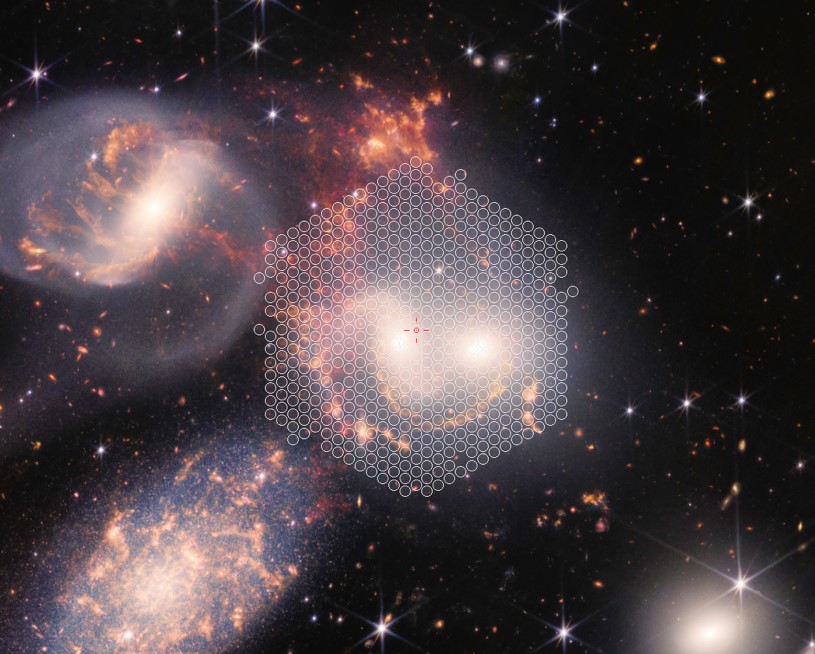
A fully-configured WEAVE field positioner plate
© WEAVE Consortium
4MOST — the 4-metre Multi-Object Spectroscopic Telescope at ESO's VISTA facility, delivering spectra of tens of millions of sources across the southern sky.
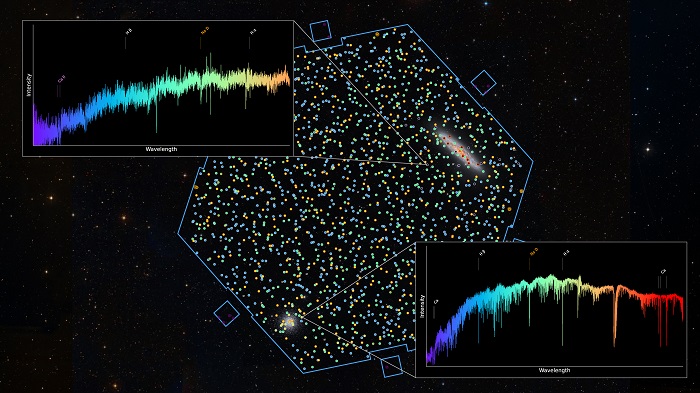
4MOST first light
© ESO / 4MOST Consortium
MOONS — the Multi-Object Optical and Near-infrared Spectrograph at ESO's Very Large Telescope, probing galaxy evolution and the Milky Way in the infrared.
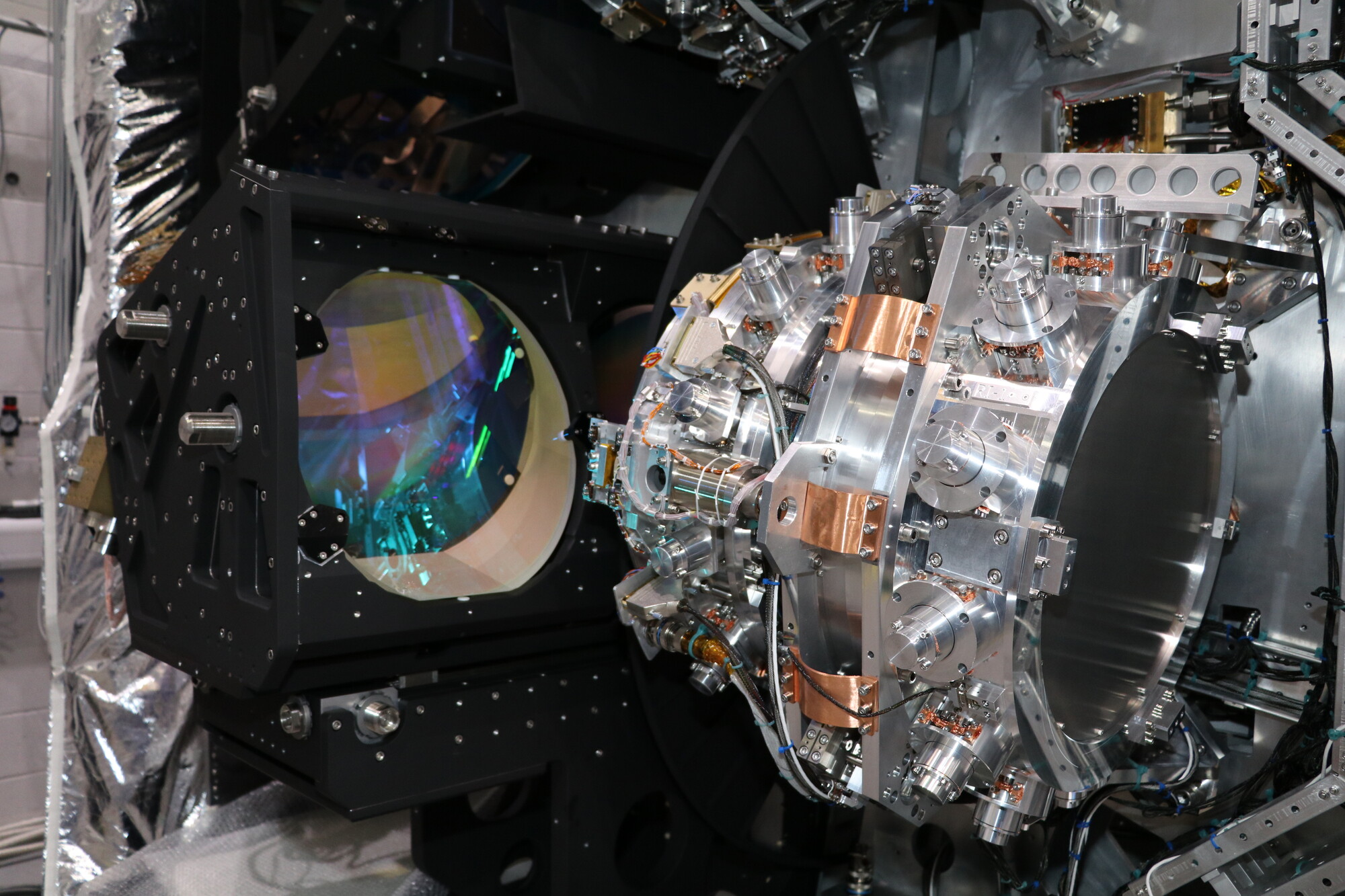
MOONS instrument at the VLT
© ESO / MOONS Consortium
WST — the Wide-field Spectroscopic Telescope, a future facility that will take multiplexed spectroscopy to an entirely new scale, for which CamCEAD contributes to the data systems design.
In space, CamCEAD contributes to missions at the frontier of stellar and planetary science:
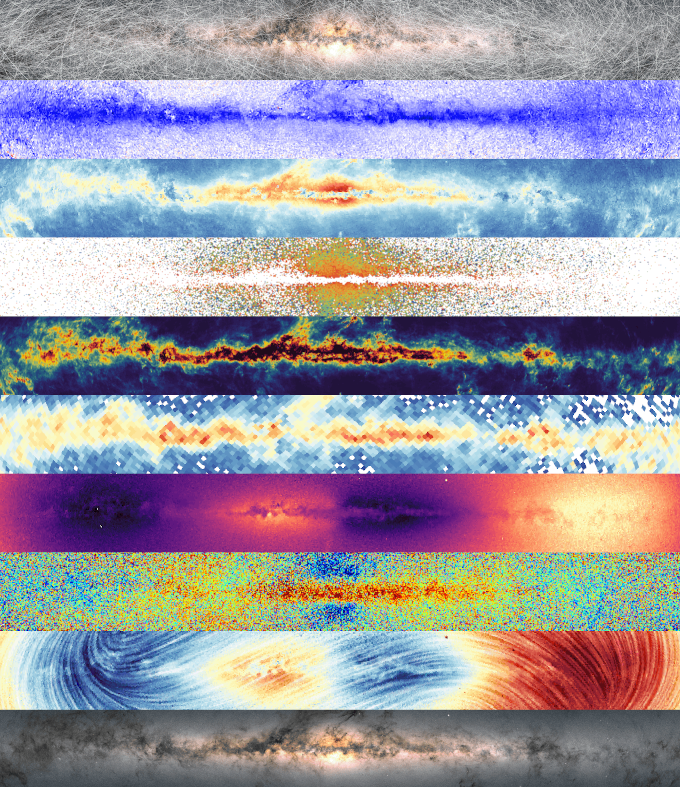
- Gaia — ESA's astrometric mission mapping over a billion stars; CamCEAD has contributed to ground-based follow-up campaigns and data validation activities including the Gaia-ESO Survey.
- PLATO — ESA's upcoming planet-finding mission, for which CamCEAD supports preparatory data infrastructure and pipeline development.
Building on decades of experience from earlier landmark programmes — including APM, the Isaac Newton Telescope Wide Field Survey, UKIDSS, VISTA, 2dF and many others — CamCEAD brings both the institutional depth and the technical capability to deliver at the scale these next-generation facilities demand.
Beyond Astronomy
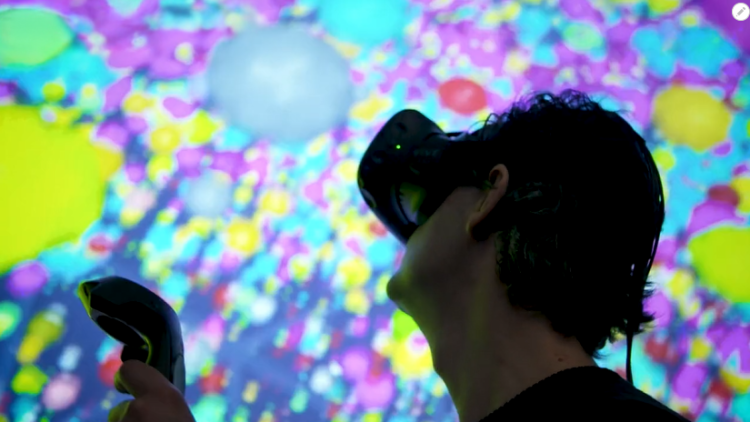
IMAXT researchers use virtual reality to navigate 3D spatial maps of tumour tissue.
© IMAXT / Cancer Research UK Cambridge Institute
The challenges of modern astronomy have driven innovations that extend well beyond the study of the Universe. The expertise developed within CamCEAD in large-scale data management, artificial intelligence, machine learning, image analysis and distributed computing is increasingly applied to data-intensive research across other scientific disciplines.
Our technologies and expertise contribute to interdisciplinary programmes in biomedical imaging and computational medicine:
- IMAXT (Imaging and Molecular Annotation of Xenografts and Tumours) — applying CamCEAD's high-throughput imaging pipelines and AI techniques to build three-dimensional spatial maps of tumours, enabling researchers to understand cancer at an unprecedented level of detail.
- SPACE — extending spatial omics and computational methods to a broader range of biological and clinical research challenges.
This cross-disciplinary approach reflects a broader vision: developing data-driven technologies that enable scientific discovery wherever complex data presents new challenges — whether that data comes from a telescope or a microscope.
Looking Towards the Future
Astronomy is entering an era defined not only by larger telescopes, but by exponentially growing datasets and increasingly sophisticated scientific questions.
Future facilities will generate unprecedented volumes of information, demanding new approaches to data processing, artificial intelligence and scientific computing:
- The Extremely Large Telescope (ELT) — the world's largest optical/near-IR telescope, coming online in the late 2020s.
- The Square Kilometre Array (SKA) — the world's largest radio telescope, generating exabytes of data per year.
- The Vera C. Rubin Observatory — producing a new image of the entire southern sky every three nights.
- The Wide-field Spectroscopic Telescope (WST) — the next leap in multiplexed spectroscopy.
- Next-generation space missions following Gaia and PLATO.
CamCEAD is helping to shape this future by developing scalable, intelligent and automated data systems capable of supporting the observatories and surveys of tomorrow. By combining a rich heritage in astronomical survey science with cutting-edge expertise in cloud computing, artificial intelligence and high-performance data processing, CamCEAD continues its mission of transforming data into discovery — enabling scientists around the world to unlock the full scientific potential of tomorrow's observations.