


CASPER is a CamCEAD R&D project developing an AI-powered assistant for astronomical survey operations, data processing, and scientific analysis, built on open-source large language models. A beta version is coming soon.
CASPER (Cambridge Astronomical Survey Personal Expert Resource) is an AI-powered assistant being developed within CamCEAD as part of our research and development programme into intelligent agents for astronomical data processing and scientific operations. Built on open-source large language models (currently based on the Llama family), CASPER combines modern AI reasoning with domain-specific knowledge of astronomical surveys, allowing it to act as both an intelligent knowledge assistant and an operational agent for survey data management.
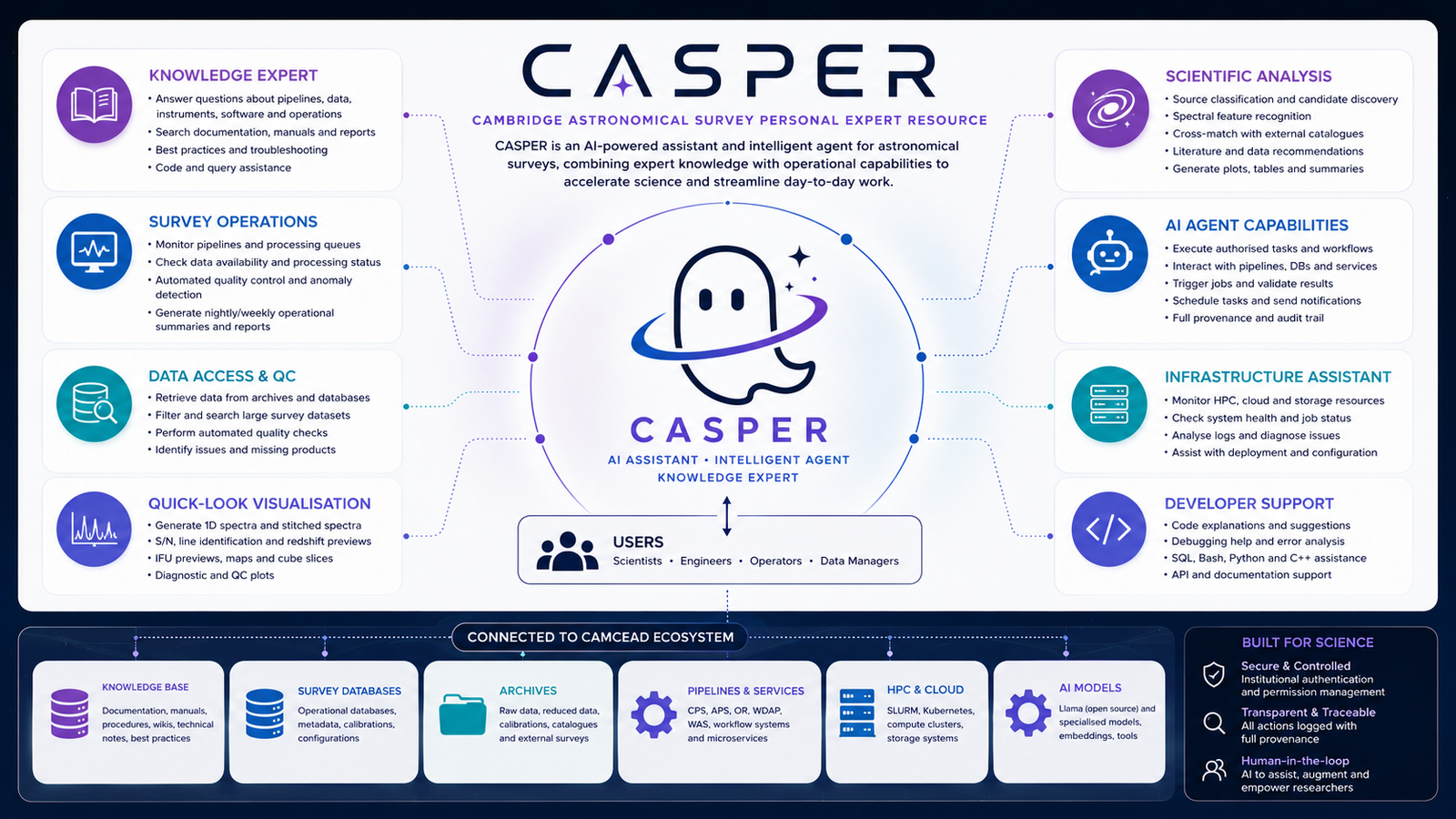
Unlike general-purpose AI systems, CASPER is designed specifically for the day-to-day needs of survey scientists, software developers, pipeline operators, and data managers. It has access to institutional documentation, technical manuals, software repositories, operational procedures, calibration information, and survey metadata, enabling it to provide accurate, context-aware answers tailored to the CamCEAD environment.
Intelligent Knowledge Assistant
CASPER serves as a searchable expert knowledge base capable of answering questions about:
- Data processing pipelines and workflows
- Survey operations and observing procedures
- Instrument characteristics and calibration strategies
- Software installation, configuration, and troubleshooting
- Internal documentation and technical reports
- Database schemas and data models
- Computing infrastructure and cloud services
- Best practices for astronomical data analysis
- Programming support in Python, SQL, Bash, C++, and scientific libraries
- Frequently asked operational and technical questions
By understanding natural language rather than relying solely on keyword searches, CASPER enables users to find information quickly, reducing time spent navigating extensive documentation.
Intelligent Survey Operations
Beyond answering questions, CASPER is being developed as an autonomous operational assistant capable of interacting directly with survey infrastructure. Planned and current capabilities include:
- Retrieving observational data from multiple archive systems
- Searching and filtering large survey databases
- Monitoring pipeline status and processing queues
- Performing automated quality-control checks
- Identifying missing or failed processing steps
- Summarising nightly survey activities
- Detecting anomalies within processing logs
- Generating operational reports automatically
- Assisting with routine survey monitoring tasks
These capabilities aim to reduce repetitive manual work while improving operational efficiency and consistency.
Automated Data Visualisation
CASPER can automatically generate quick-look visualisations for rapid data inspection, including:
- One-dimensional extracted spectra
- Multi-arm stitched spectra
- Signal-to-noise diagnostics
- Sky-subtraction quality assessments
- Emission and absorption line identification
- Redshift visualisation
- IFU spaxel previews
- Cube slices and integrated maps
- Pipeline diagnostic plots
- Interactive inspection figures
This allows users to rapidly assess data quality without manually running specialised visualisation software.
Scientific Analysis Assistant
Future versions of CASPER are being designed to assist astronomers throughout the scientific analysis process by providing:
- Automatic source classification
- Candidate object identification
- Spectral feature recognition
- Literature recommendations
- Observation planning assistance
- Target prioritisation
- Cross-matching with external catalogues
- Statistical summaries of survey samples
- AI-assisted interpretation of data products
- Generation of publication-ready plots and tables
Rather than replacing scientific judgement, CASPER is intended to accelerate routine analysis and allow researchers to focus on scientific interpretation.
Infrastructure and Software Assistant
CASPER is also envisioned as an intelligent DevOps and systems assistant capable of interacting with computational infrastructure. Planned features include:
- Monitoring compute clusters and cloud resources
- Checking storage availability and system health
- Managing processing jobs
- Monitoring Kubernetes and SLURM workloads
- Querying PostgreSQL databases
- Analysing system logs
- Diagnosing common failures
- Assisting with software deployment
- Generating configuration templates
- Providing code suggestions and debugging support
This creates a unified interface between users and complex computing infrastructure.
AI Agent Framework
One of CASPER's long-term goals is to evolve beyond a conversational assistant into a collaborative AI agent capable of executing complex workflows autonomously. Through secure integrations with existing CamCEAD services, CASPER will be able to:
- Execute authorised tasks on behalf of users
- Coordinate multi-step processing workflows
- Interact with databases, archives, and web services
- Trigger pipeline executions
- Validate processing outputs
- Schedule automated tasks
- Generate notifications and operational summaries
- Produce reproducible reports with full provenance
Human oversight remains central to this approach, with configurable permission levels ensuring that autonomous actions are transparent, traceable, and fully auditable.
Future Directions
CASPER is being developed as a long-term research platform for AI-driven astronomical infrastructure. Planned areas of development include:
- Multi-agent collaborative workflows
- Retrieval-Augmented Generation (RAG) over institutional knowledge bases
- Integration with telescope operations and observing systems
- Automated scientific workflow orchestration
- Voice-enabled interfaces
- Interactive dashboards
- Secure institutional authentication
- Personalised assistants for individual researchers
- Integration with Git repositories and issue trackers
- Support for multiple astronomical surveys and instruments
As large astronomical surveys continue to increase in scale and complexity, intelligent assistants such as CASPER have the potential to become an integral part of scientific data centres, helping researchers interact naturally with increasingly sophisticated data processing and analysis infrastructures.
CASPER represents CamCEAD's vision for the next generation of AI-assisted astronomical survey operations, where modern language models, autonomous agents, and scientific software work together to enhance productivity, improve operational efficiency, and accelerate scientific discovery.
CamCEAD Collaborators
Assistant Research Professor

Senior Research Associate

Assistant Research Professor

Research Professor (Director of CamCEAD)