
CamCEAD introduces CASPER, an AI research platform for astronomical survey knowledge and operations
23 September 2026
CamCEAD is piloting CASPER (Cambridge Astronomical Survey Personal Expert Resource), an assistant platform for astronomical survey teams. It answers technical questions from curated project documents, shows where each answer comes from, and can carry out approved tasks for the people who use it.
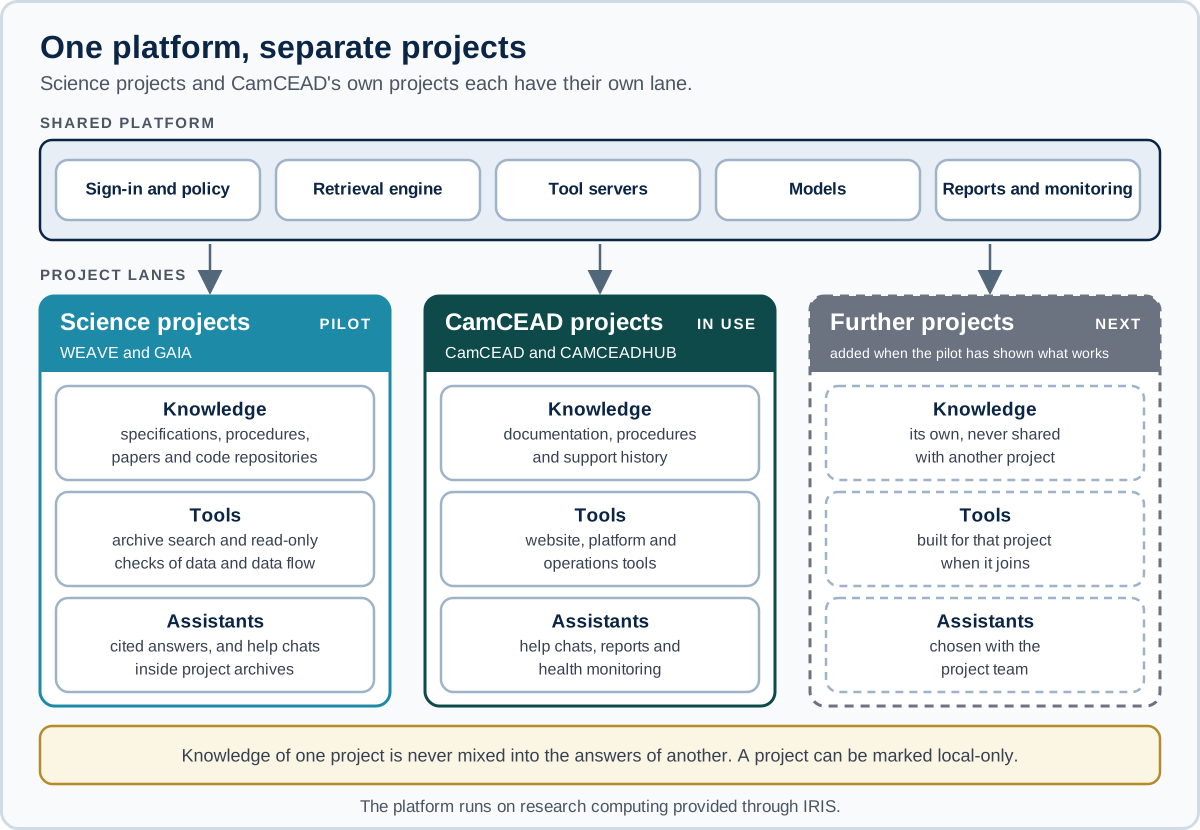
Update, 16 October 2026. CASPER already serves several projects: CamCEAD's own platforms, CamCEAD and CAMCEADHUB, and the science projects WEAVE and GAIA, which are on board in our pilot. The open models that we host ourselves are moving from the Llama family to the Mistral family. CASPER is in beta and is not open to the public.

What it does
Survey projects run on long specifications, procedures that change and knowledge that often sits with a few specialists. CASPER reads the material a project has chosen to share, finds the passages that bear on a question and writes an answer that points back to them. When nothing supports an answer it says so.
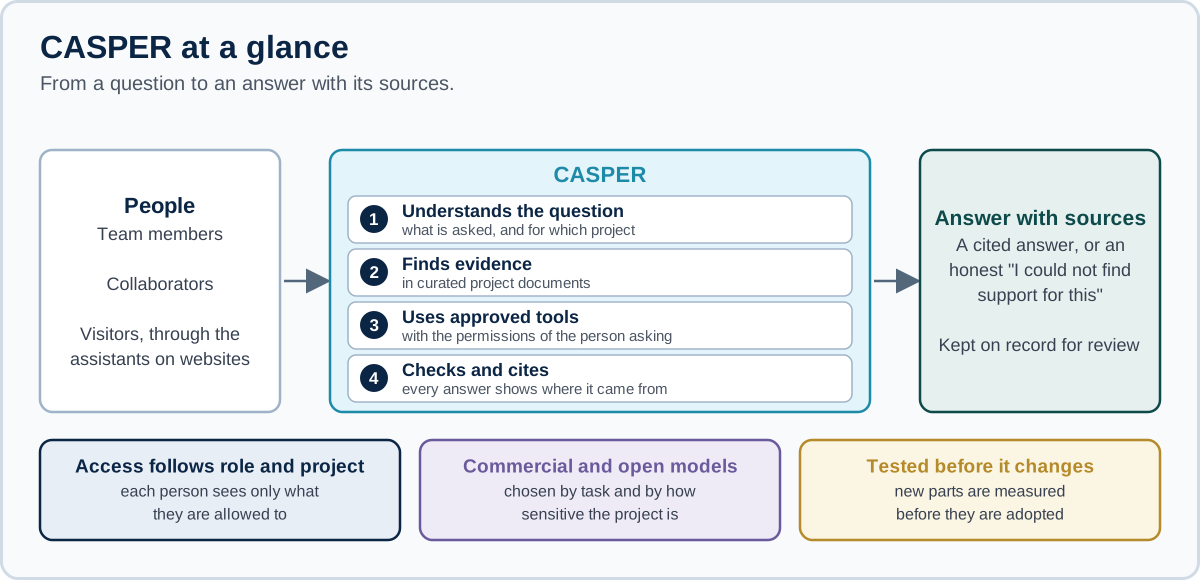
CASPER is developed in house by CamCEAD. Its main parts are a multi-layer retrieval system that searches documents in five complementary ways and checks every citation, a family of tool servers built on the Model Context Protocol (MCP) for survey data, pipelines and project systems, specialist agents for different tasks and projects, and monitoring and reporting for the projects it supports. Short assistants also work inside websites, including the help chat on this site and the search assistant in the WEAVE archive.
One platform, many projects
Each project has its own lane on the shared platform, with its own knowledge, tools, assistants and privacy setting. The knowledge of one project is never mixed into the answers of another. For CamCEAD and CAMCEADHUB, CASPER holds documentation and procedures, provides tools for the website and the platform, and produces health checks and reports. In the science pilot, WEAVE has its specifications and operations notes, read-only checks of the data flow and assistants inside its archive, and GAIA has its documents, publications and software repositories as a separate knowledge base that team members search from the CASPER website or from their own AI desktop client.
Models
CASPER combines commercial models with open models that CamCEAD hosts and manages on research computing. A router chooses between them by the task and by how sensitive the project is, and a project marked local-only is answered entirely on our own hardware. The open models we host today are from the Llama family. We are migrating to the Mistral family, one lane at a time and after measuring each model on our own reference questions, so nothing changes for the people who use CASPER. Models are not trained on user conversations.
Trust and limits
Each person sees only what their role and project allow, answers and actions are recorded for review, and anything that would change a system needs an administrator and an explicit confirmation. CASPER can still be wrong, which is why every answer carries its sources.
With IRIS
CASPER runs on research computing provided through IRIS, the e-infrastructure for STFC science, and IRIS is an external collaborator on the project. A full technical description will follow in a peer-reviewed paper.
The science pilot shows what works. Once it has finished, we plan to extend CASPER to further surveys and programmes. Read more on the CASPER project page.