
WEAVE discovers a mysterious iron bar in the Ring Nebula
16 January 2026
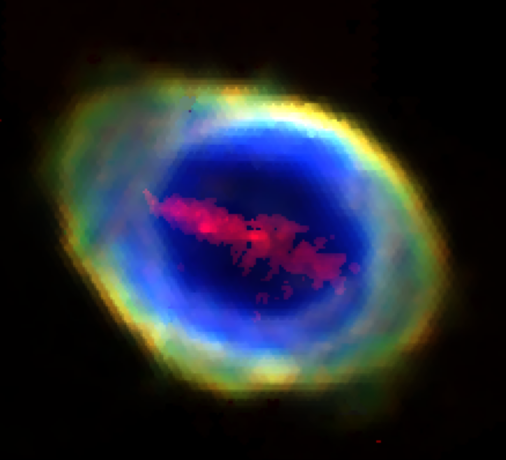
A European research team from University College London and Cardiff University has identified a previously unknown bar-shaped iron cloud within the Ring Nebula (Messier 57, NGC 6720) using WEAVE, the advanced integral-field spectrograph mounted on the William Herschel Telescope at La Palma. The discovery is published in Monthly Notices of the Royal Astronomical Society.
The iron bar fits within the inner elliptical layer of the nebula, extending roughly 500 times the length of Pluto's solar orbit. Its iron mass is estimated to rival that of Mars. The Ring Nebula, first documented in 1779 by Charles Messier, represents material ejected by a dying star — a fate our own Sun will share in several billion years.
A new window on a well-studied object
Researchers used WEAVE's Large Integral Field Unit (LIFU) mode, which bundles hundreds of optical fibres to simultaneously capture light spectra across the entire nebula at all optical wavelengths. This enabled detailed compositional mapping previously unavailable through any other observatory.
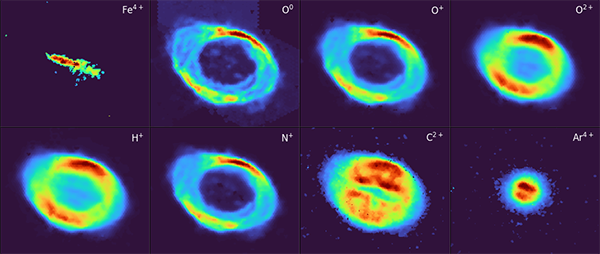
"Even though the Ring Nebula has been studied using many different telescopes and instruments, WEAVE has allowed us to observe it in a new way, providing so much more detail than before."
— Dr Roger Wesson, University College London / Cardiff University
Origin still unexplained
Two hypotheses exist for the bar's origin: it may reveal new information about the nebula's ejection process, or it could represent a stretched plasma arc from a vaporised rocky planet caught in the dying star's expansion. Professor Janet Drew (UCL) emphasised: "We definitely need to know more — particularly whether any other chemical elements co-exist with the newly-detected iron."
Professor Scott Trager (University of Groningen), WEAVE Project Scientist, added: "The discovery of this fascinating, previously unknown structure in a night-sky jewel, beloved by sky watchers across the Northern Hemisphere, demonstrates the amazing capabilities of WEAVE."
Dr Wesson noted: "It would be very surprising if the iron bar in the Ring is unique." The team plans follow-up observations at higher spectral resolution, and anticipates finding similar features in other planetary nebulae as WEAVE continues its survey programme.
Reference: Wesson, Richard et al. (2026), "WEAVE imaging spectroscopy of NGC 6720: an iron bar in the Ring", MNRAS, doi:10.1093/mnras/staf2139.
Source: ING Press Release, 16 January 2026 — Isaac Newton Group of Telescopes