

➜ Visit CAMCEADHUB — sign in or register to start using the platform.
CAMCEADHUB (CASU-IRIS) is CamCEAD's cloud-based scientific analysis platform for CASU users, giving researchers on-demand computational resources and streamlined access to data without needing to manage their own infrastructure.
Modern astronomical research increasingly outgrows the laptop and the desktop workstation — datasets from surveys like Gaia, 4MOST, WEAVE and MOONS run to terabytes, and the software needed to process them (astropy, photutils, TensorFlow, GDL, and more) needs real compute behind it. CAMCEADHUB exists so that researchers can get straight to the science: request a server, get a fully-configured astronomy environment in seconds, and start working — no cluster administration, no dependency wrangling, no waiting on IT to provision a machine.
Why researchers use CAMCEADHUB
- No infrastructure to manage. Every environment is pre-built with the scientific Python stack, astronomy tools, and remote development tooling already installed and ready to go.
- Scale on demand. Pick a small server for interactive exploration, or a large, GPU-accelerated one for training a model or reducing a night's data — the same platform, the same login, the same storage, whatever the job needs.
- Work the way you already do. JupyterLab, RStudio, or your own local VS Code connected via a remote tunnel — CAMCEADHUB meets you in the tool you already use, rather than asking you to learn a new one.
- Collaborate without friction. Built-in file sharing means sending a colleague a dataset, or giving a whole project team access to shared results, takes seconds rather than an email chain and a USB stick.
- Backed by national infrastructure. CAMCEADHUB runs on IRIS, the UK's e-Infrastructure for Research and Innovation for STFC, not on ageing departmental hardware — giving CASU researchers access to serious, well-maintained compute at national-facility scale.
What CAMCEADHUB provides
Built on cloud principles, CAMCEADHUB gives scientists a self-service dashboard for launching and managing their own compute environments, running data-processing pipelines, and tracking jobs — all backed by dedicated storage and compute infrastructure.
A real astronomy working environment, not a bare notebook
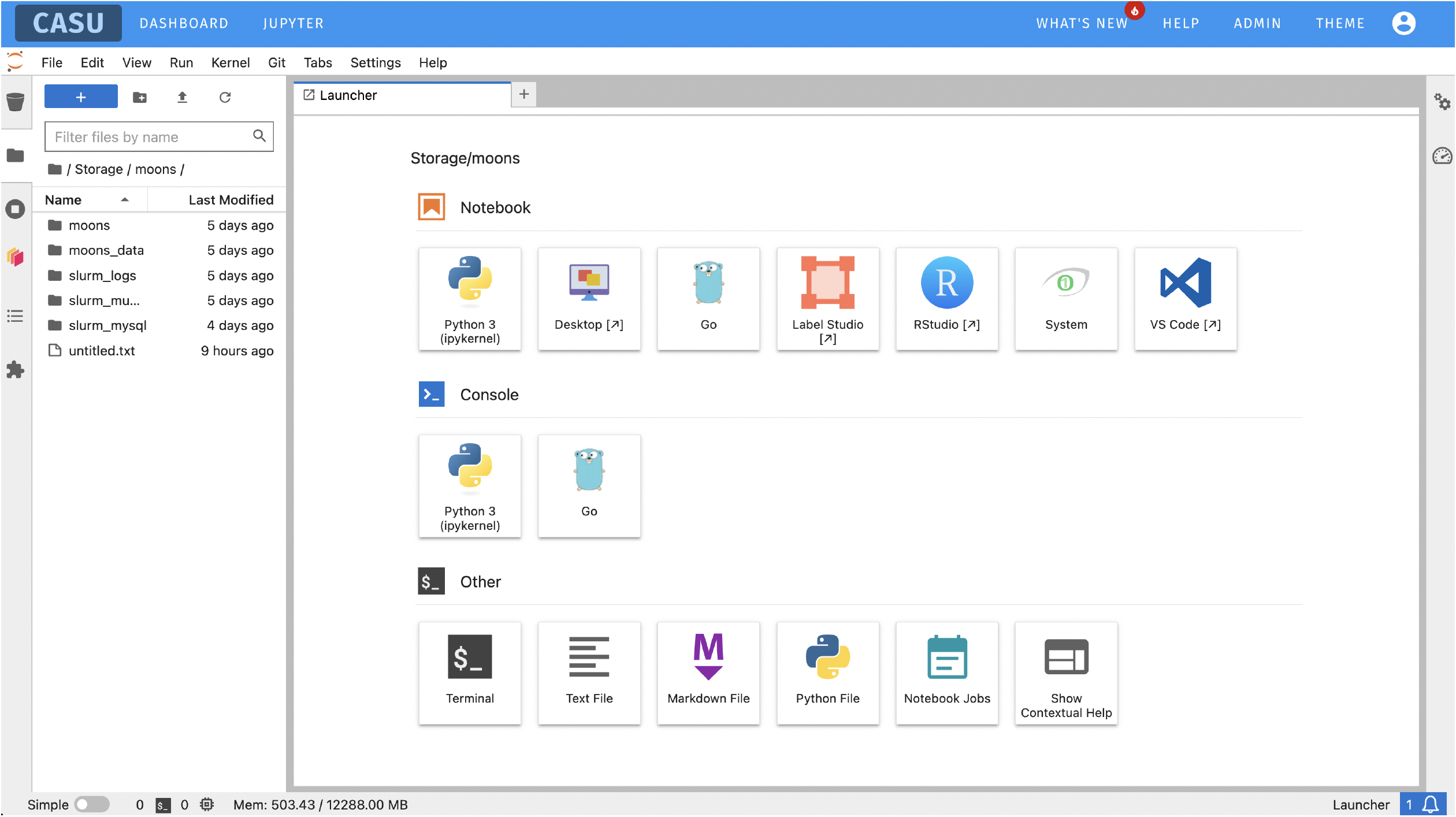
Every JupyterLab session comes with a genuine astronomy software stack already installed and configured, so there's no setup step between logging in and starting work:
- Scientific Python: astropy, photutils, numpy, scipy, pandas, matplotlib, and the wider astronomy Python ecosystem, pre-installed and version-matched.
- SAOImage DS9 for interactive FITS image inspection, alongside Aladin for sky visualization.
- R and RStudio, for statistical analysis alongside the Python tooling.
- GPU-accelerated computing, with TensorFlow and CUDA available on GPU-enabled server tiers, for machine-learning and deep-learning workflows.
- Remote desktop environments (browser-based noVNC or full TurboVNC) for applications that need a real desktop, not just a notebook.
- Visual Studio Code, either directly in the browser or connected to your own local VS Code installation via a secure Remote Tunnel — edit and debug exactly as you would locally, with the compute running on CAMCEADHUB.
- Git integration built into the JupyterLab interface, for version-controlling analysis code and notebooks alongside the science.
Key features
- Interactive environments — JupyterLab notebooks, RStudio, Visual Studio Code and full remote desktop sessions, launched on request.
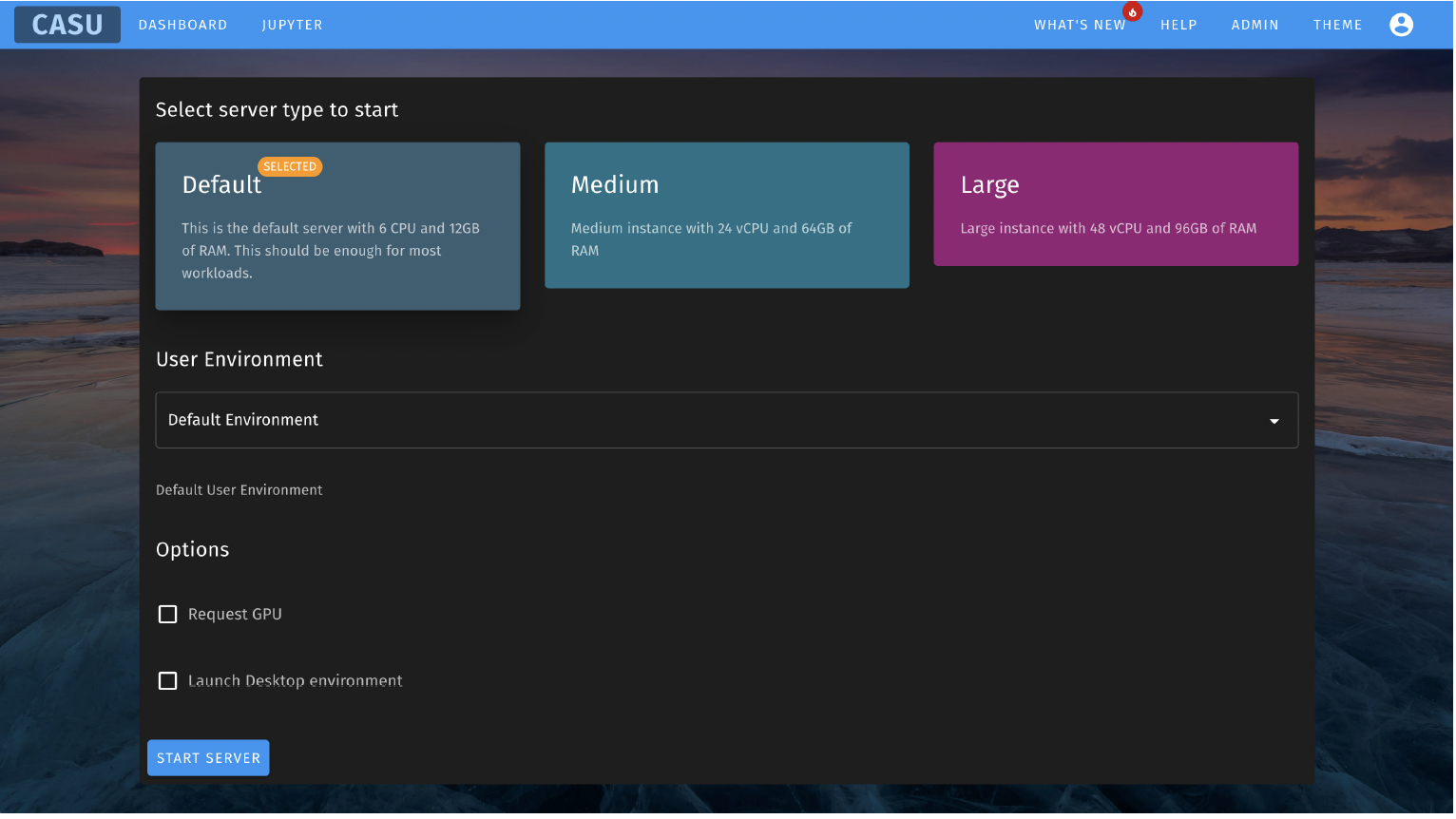
- Flexible server sizes — choose from Default, Medium, Large or XLarge server instances (with optional GPU acceleration), sized to the task at hand. Larger tiers may be limited to specific projects depending on demand.
- Pipelines & batch jobs — submit and monitor long-running data-processing jobs from the dashboard.
- Cloud storage & file sharing — every account gets its own private S3-compatible storage space, with a built-in web interface for browsing, uploading and sharing files with colleagues.
- Security by default — every account is protected by two-factor authentication, and CamCEAD members can sign in directly with their University of Cambridge Raven credentials.
Hosted on IRIS — real scale, not a shared laptop
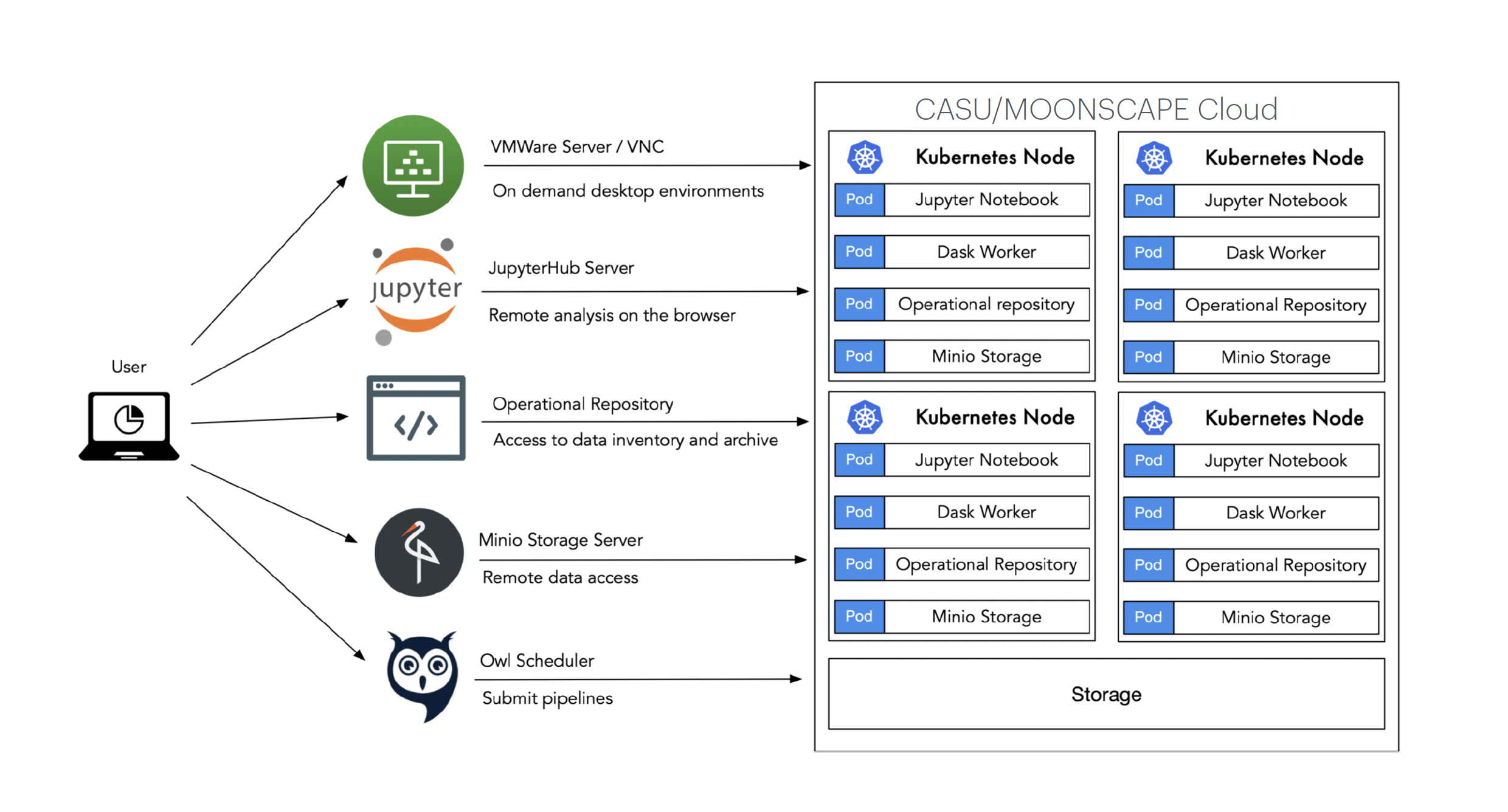
Unlike CamCEAD's other cloud platforms, CAMCEADHUB runs on IRIS — the UK's e-Infrastructure for Research and Innovation for STFC — rather than on CamCEAD's own hardware. For the 2026 allocation, the platform has access to 1,980 VCPUs, alongside dedicated GPUs, several terabytes of RAM and multiple petabytes of storage, distributed across a Kubernetes cluster of master and compute nodes. That scale means a server request is answered in seconds, not queued behind other users' jobs on a shared workstation.
Getting started: registration and login
Access to CAMCEADHUB is by registration and administrator approval.
To register: click Register on the CAMCEADHUB front page and fill in your name, email address, username and password. You'll receive a confirmation email with an activation link — once you click it, an administrator reviews and approves new accounts before login is enabled, so there may be a short wait before you can sign in for the first time.
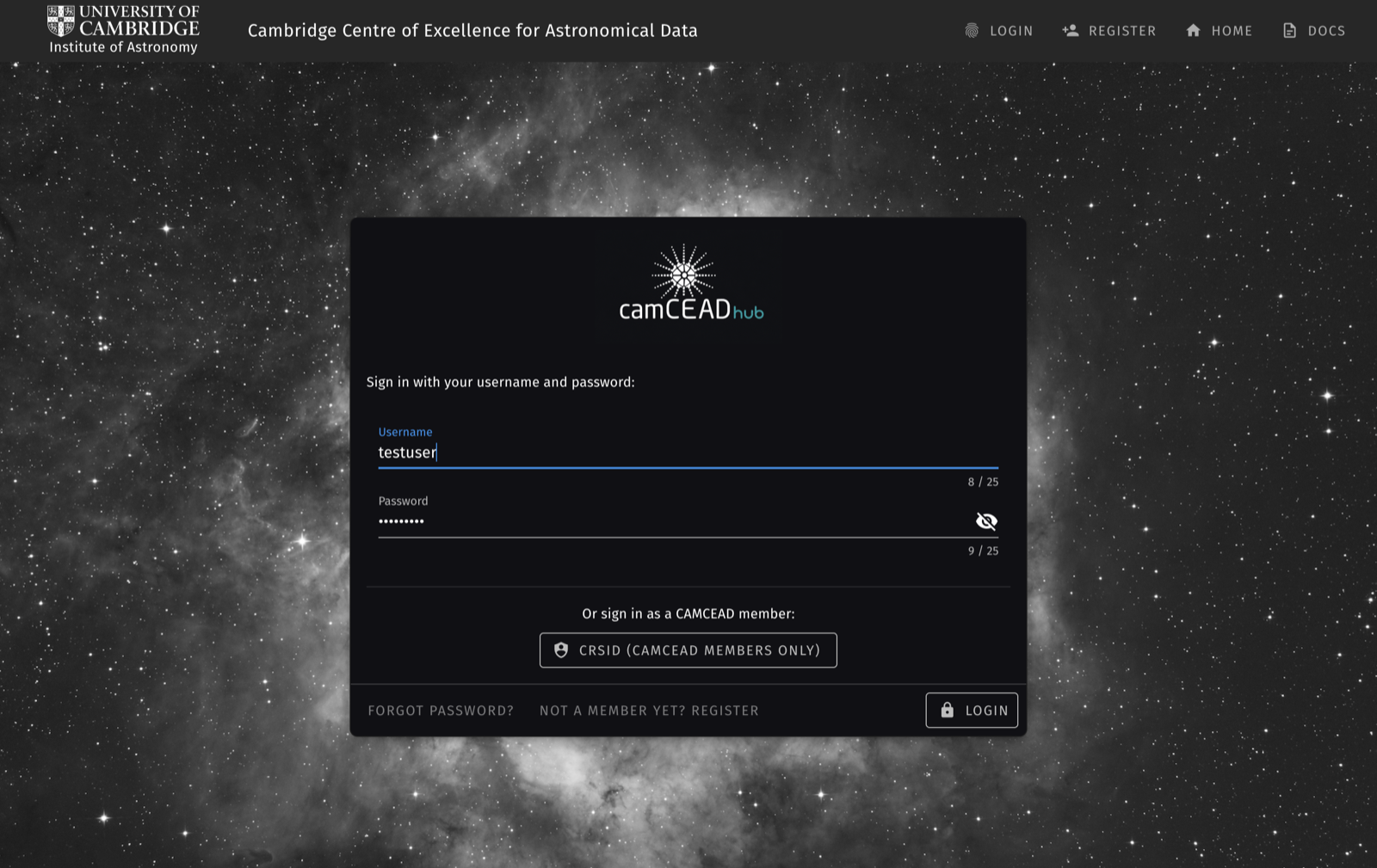
Signing in: enter your username and password, then a second authentication step — every account has two-factor authentication enabled by default. Generate a code with an authenticator app (Google Authenticator, Authy, or similar), or, if you don't have one to hand, request a one-time code by email instead.
Once logged in, the dashboard shows a summary of your account, storage usage, running Jupyter servers and job status, with links to every part of the platform.
Signing in as a CamCEAD member (CRSid / Raven)
CamCEAD members can also sign in using their University of Cambridge Raven account, as a faster, more secure alternative to a separate CAMCEADHUB password. On the sign-in page, click CRSid (CamCEAD members only) and authenticate with Raven as normal — you'll be signed in directly, without a separate password or two-factor step, since Raven's own sign-in already covers that.
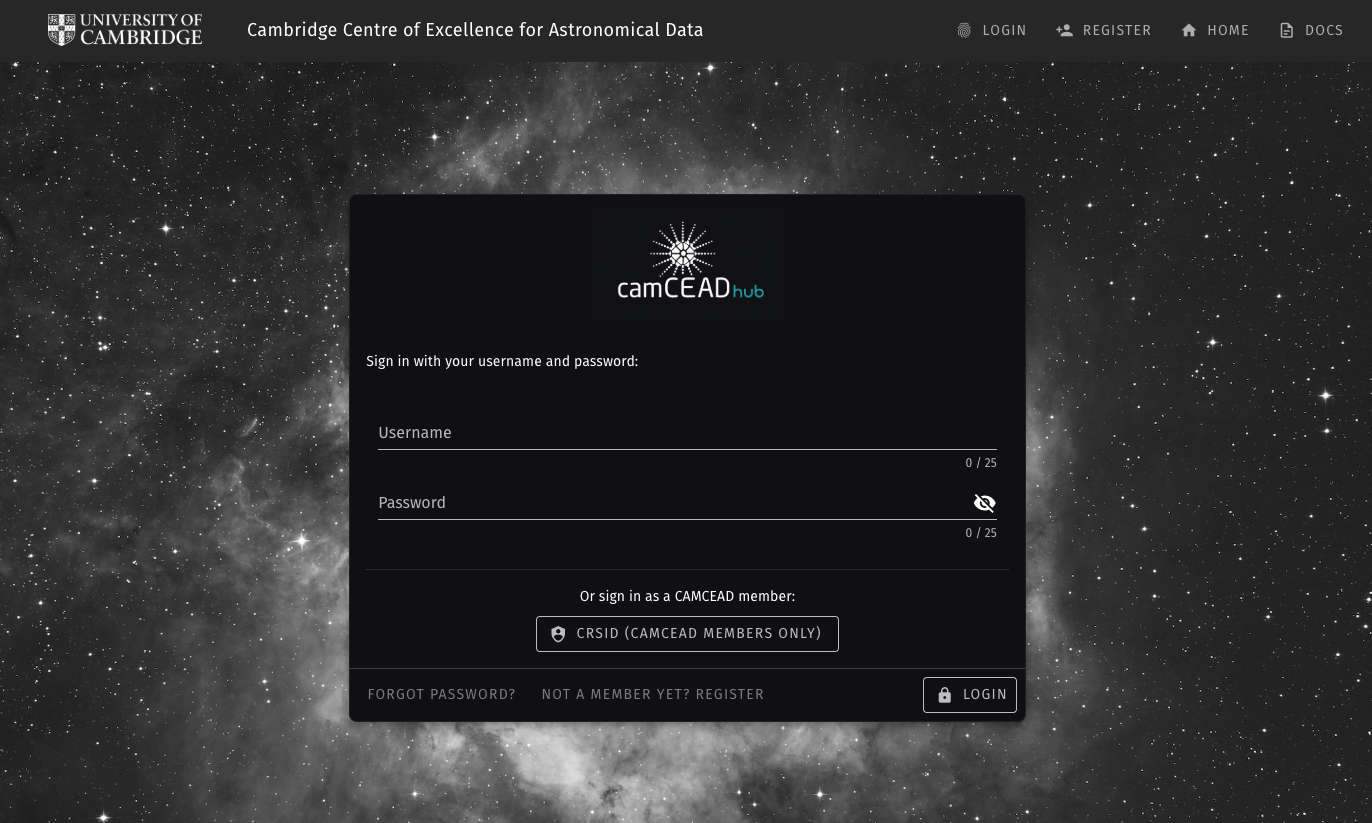
You still need a registered CAMCEADHUB account first — Raven login doesn't create one automatically. Add your CRSid either when you register, or afterwards from your Profile settings page. Note that your CRSid and your CAMCEADHUB username don't have to match (for example, someone might register as jsmith but sign in with Raven via CRSid js1234) — the platform looks up your account by CRSid, not by username.
Data storage and file sharing
Every CAMCEADHUB account includes a private, S3-compatible cloud storage bucket — your own persistent, high-capacity space that stays with you regardless of which server you're running, accessible three ways:
- The Storage page in the dashboard — browse your files in the browser, upload individual files or entire folders, and download or delete them. Uploads can be cancelled part-way through, and multiple files can be selected for bulk deletion.
- From your own computer — using a command-line client (mc, the MinIO client) or a graphical S3 client (CyberDuck, MountainDuck, Transmit, WinSCP), using the access credentials shown on your Profile page. Move a dataset onto the platform before you start work, or pull results back down onto your own machine when you're done.
- From inside a running Jupyter server — command-line access is pre-configured automatically, with no setup needed; every session already has mc and boto3 (Python) ready to use against your own bucket, so a notebook can read and write your storage directly.
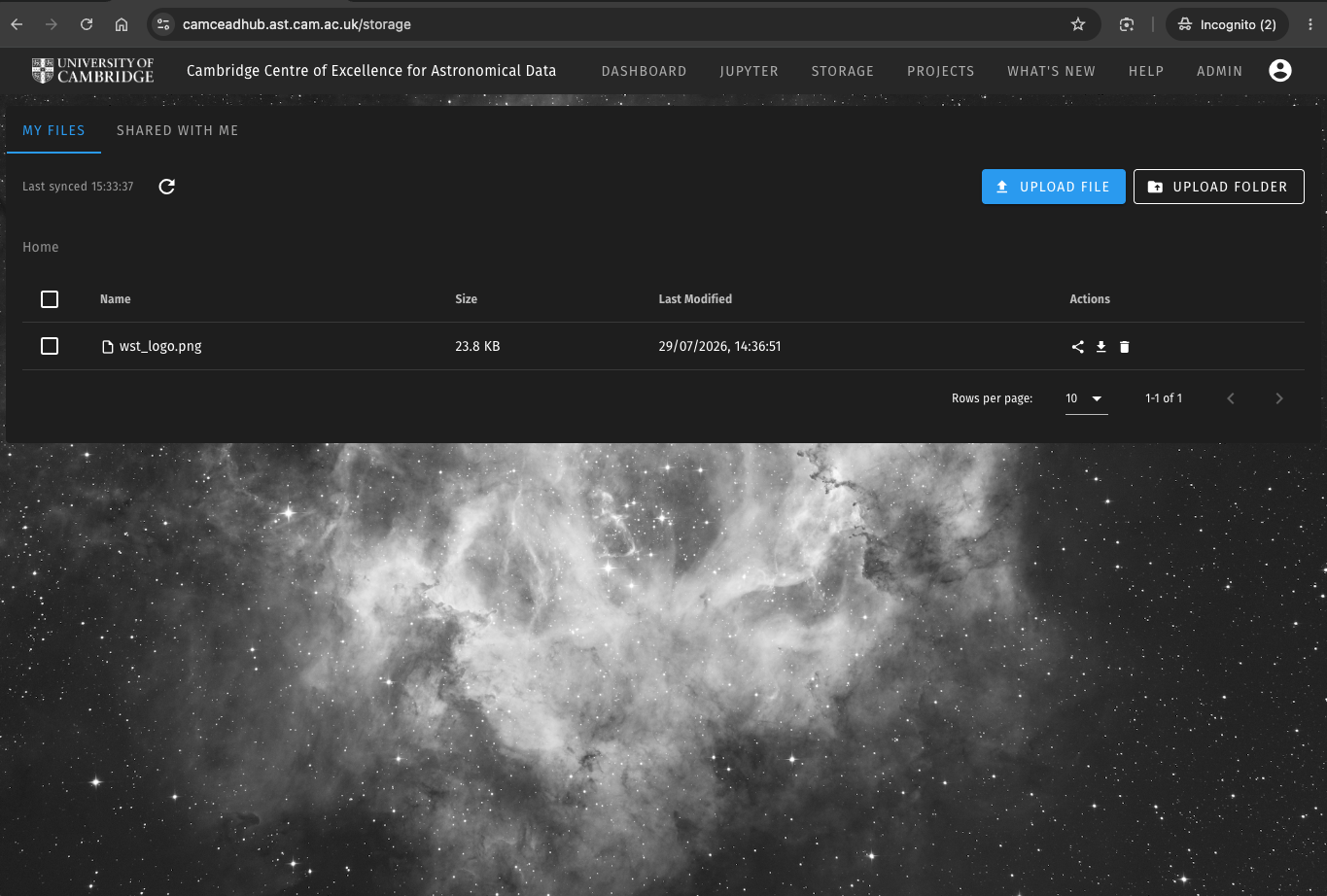
Sharing files — collaboration without the email attachments
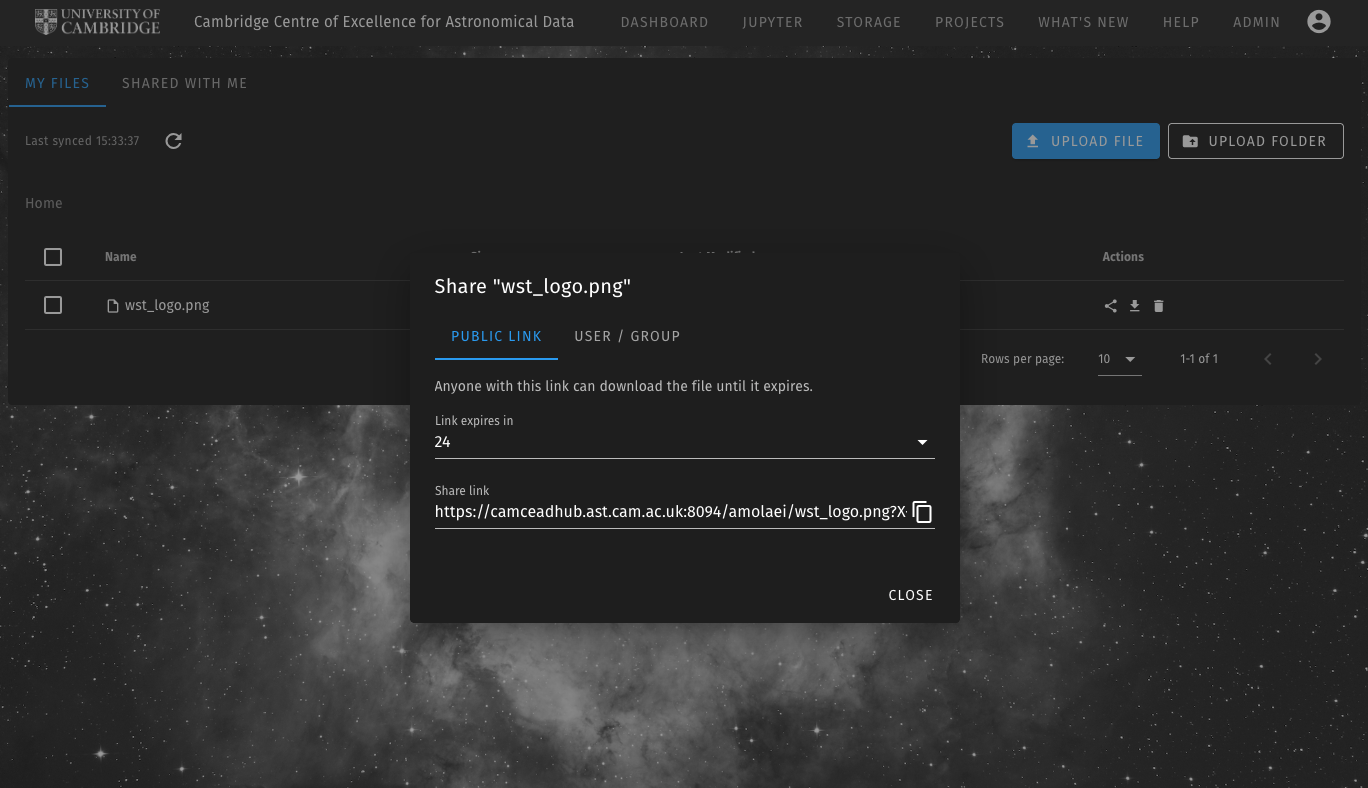
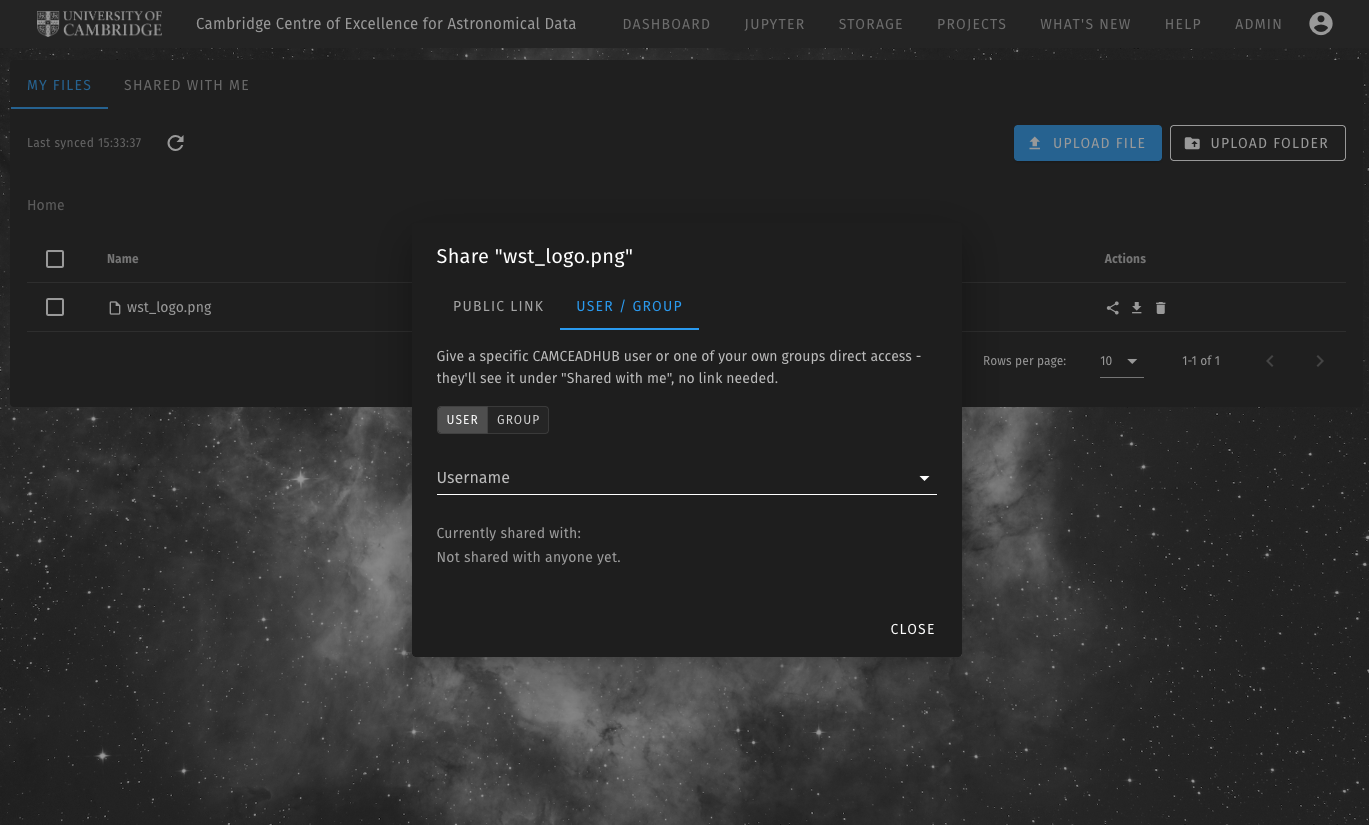
Files and folders can be shared two ways directly from the Storage page:
- Public link — generates a temporary download link (valid for 1 hour, 1 day or 7 days) that anyone can use, no CAMCEADHUB account required. Ideal for sharing a plot, a results file, or a dataset with an external collaborator or a journal reviewer.
- Direct sharing — grant a specific CAMCEADHUB user, or one of your own project groups, direct access to a file or folder. Shared items appear under that person's own "Shared with me" tab, with no link needed, and access can be revoked at any time. A whole project team can be given access to a shared results folder in one step.
Members of certain projects (e.g. WEAVE, MOONS) also have that project's shared network storage automatically available inside their Jupyter sessions, alongside their own personal storage — so project-wide datasets are already there the moment a session starts.